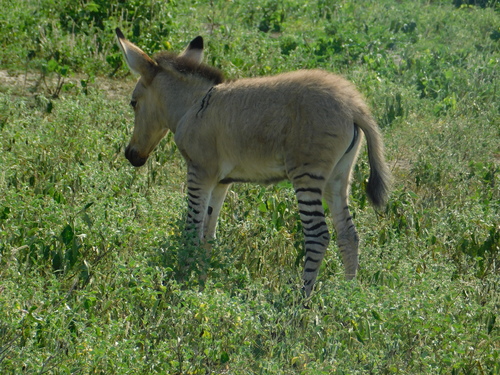
Donkey × Plains Zebra
Equus asinus × quagga
English
The donkey or ass is a domesticated equine. It derives from the African wild ass, Equus africanus, and may be classified either as a subspecies thereof, Equus africanus asinus, or as a separate species, Equus asinus. It was domesticated in Africa some 5000–7000 years ago, and has been used mainly as a working animal since that time. There are more than 40 million donkeys in the world, mostly in underdeveloped countries, where they are used principally as draught or pack animals. While working donkeys are often associated with those living at or below subsistence, small numbers of donkeys or asses are kept for breeding, as pets, and for livestock protection in developed countries. An adult male donkey is a jack or jackass, an adult female is a jenny, jenny ass, or jennet, and an immature donkey of either sex is a foal. Jacks are often mated with female horses (mares) to produce mules; the less common hybrid of a male horse (stallion) and jenny is a hinny.
Français · Equus asinus × quagga
L'Âne commun, appelé plus communément « Âne », est une espèce de mammifères herbivores et ongulés appartenant à la famille des équidés. Souvent comparé au cheval, l'âne a des caractéristiques morphologiques propres qui le différencient clairement de son cousin, ses longues oreilles étant son attribut le plus facilement identifiable. Ces dernières lui offrent une ouïe particulièrement fine, et qui, complétée par un large champ de vision et un odorat fort développé, lui permettent une bonne perception du monde qui l'entoure. Baudet est le nom donné au mâle reproducteur. Les femelles, appelées ânesses, mettent bas après douze mois de gestation un petit nommé ânon. Celui-ci peut se lever et courir peu de temps après sa naissance. L'âne peut également s'hybrider avec d'autres équidés, par exemple avec la jument pour donner naissance à un nouvel animal, le mulet.
Español · cebroide
El burro, asno, jumento, borrico o pollino es un animal doméstico de la familia de los équidos. Los ancestros silvestres africanos de los burros fueron domesticados por primera vez a principios del vii milenio a. C., dos siglos antes que los caballos de Eurasia, y desde entonces han sido utilizados por el ser humano como animales de carga y como cabalgadura. La aparición de la maquinaria agrícola ha supuesto un descenso considerable en sus poblaciones.
Русский · Equus asinus × quagga
Дома́шний осёл, или иша́к — одомашненный потомок дикого осла, сыгравший важную историческую роль в развитии хозяйства и культуры человека и по-прежнему широко распространённый в хозяйстве многих развивающихся стран. Небольшое количество ослов содержится для разведения или в качестве домашних животных в развитых странах.
العربية · حمار × حمار الزرد السهلي
الحمار هو حيوان من جنس الخيل، وهو حيوان أليف، ويوجد نوع يعيش بصورة برية في وديان وصحاري أفريقيا وآسيا وبراريها ويسمى بالحمار الوحشي. الحمار من الفصيلة الخيلية، رتبة مفردات الأصابع، من طائفة الثدييات، من شعبة الحبليات التابعة للمملكة الحيوانية من الكائنات الحية. هو الرفيق الدائم للإنسان، حامل المشقة، والمستأنس منه مع تنوع عائلته، مايزال في دوره القديم، رغم أن قريبه الأوناغر البريّ مهدد بالانقراض. ويسمى صغير الحمار جحش.
中文 · Equus asinus × quagga
驴 是常见的马科马属家畜,是非洲野驴被人类驯化所形成的亚种,和马体形相似,但耳朵长,尾巴有尾柄,类似牛尾巴。
Photo: Athuman Komora Garisse · CC-BY-NC · View on iNaturalist · Wikipedia
See my other TRMNL plugins