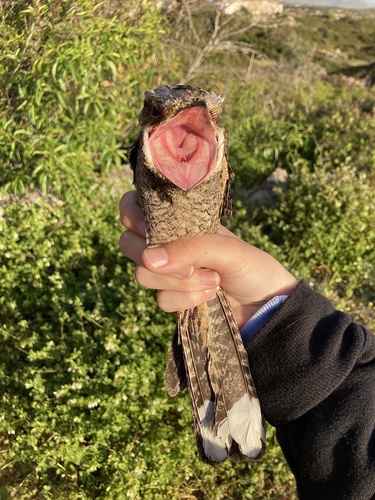
Eurasian Nightjar
Caprimulgus europaeus
English
The European nightjar (Caprimulgus europaeus), common goatsucker, Eurasian nightjar or just nightjar is a crepuscular and nocturnal bird in the nightjar family that breeds across most of Europe and the Palearctic to Mongolia and Northwestern China. The Latin generic name refers to the old myth that the nocturnal nightjar suckled from goats, causing them to cease to give milk. The six subspecies differ clinally, the birds becoming smaller and paler towards the east of the range. All populations are migratory, wintering in sub-Saharan Africa. Their densely patterned grey and brown plumage makes individuals difficult to see in the daytime when they rest on the ground or perch motionless along a branch, although the male shows white patches in the wings and tail as he flies at night. The preferred habitat is dry, open country with some trees and small bushes, such as heaths, forest clearings or newly planted woodland. The male European nightjar occupies a territory in spring and advertises his presence with a distinctive sustained churring trill from a perch. He patrols his territory with wings held in a V and tail fanned, chasing intruders while wing-clapping and calling. Wing clapping also occurs when the male chases the female in a spiralling display flight. The European nightjar does not build a nest, and its two grey and brown blotched eggs are laid directly on the ground; they hatch after about 17–21 days and the downy chicks fledge in another 16–17 days. The European nightjar feeds on a wide variety of flying insects, which it seizes in flight, often fly-catching from a perch. It hunts by sight, silhouetting its prey against the night sky. Its eyes are relatively large, each with a reflective layer, which improves night vision. It appears not to rely on its hearing to find insects and does not echolocate. Drinking and bathing take place during flight. Although it suffers a degree of predation and parasitism, the main threats to the species are habitat loss, disturbance and a reduction of its insect prey through pesticide use. Despite population decreases, its large numbers and huge breeding range mean that it is classified by the International Union for Conservation of Nature as being of least concern.
Français · Engoulevent d'Europe
L'Engoulevent d'Europe est une espèce d'oiseaux de la famille des Caprimulgidae. Comme tous les engoulevents, c'est un oiseau crépusculaire et nocturne. Il possède un plumage cryptique très complexe, mêlant le gris, le beige et le brun, qui lui confère un camouflage efficace le jour, lorsqu'il reste posé au sol ou perché, immobile, le long d'une branche. En vol, le mâle arbore cependant des taches blanches bien visibles sur les coins de la queue et au bout des ailes. Le cou est court, portant une grosse tête munie d'un petit bec. Les ailes et la queue sont longues et étroites ; les pattes sont courtes. L'Engoulevent d'Europe se nourrit d'une grande variété d'insectes volants, qu'il attrape en vol, souvent en chassant depuis un perchoir. Il chasse à vue, utilisant ses yeux relativement grands et munis d'une couche réfléchissante qui améliore sa vision de nuit. Il ne semble pas utiliser son ouïe pour chasser, et ne fait pas d'écholocalisation. Il boit et se baigne au vol.
Español · Chotacabras Europeo
El chotacabras europeo o chotacabras gris es una especie de ave caprimulgiforme de la familia Caprimulgidae que habita en Eurasia y África. Se distribuye por las zonas templadas de matorral, pastizales o los claros de los bosques del Viejo Mundo. Son aves nocturnas y crepusculares, de plumajes crípticos que tienen largas alas y patas y picos cortos, y se alimentan de insectos en vuelo. Tanto su nombre científico como su nombre común en varias lenguas europeas procede de un antiguo mito que les atribuye injustificadamente la acción de mamar de las cabras. No está amenazado a nivel global, y su población se estima entre 3 y 6 millones de ejemplares.
Русский · Козодой
Обыкнове́нный козодо́й, или просто козодой — ночная птица из семейства настоящих козодоев, гнездящаяся в умеренных широтах Евразии и в северо-западной Африке. Размером чуть крупнее дрозда, отличается неброским серовато-бурым оперением, хорошо скрывающим птицу на фоне коры или лесной подстилки. Как и другие виды семейства, имеет большие глаза, короткий клюв в сочетании с очень большим («лягушачьим») разрезом рта и короткие ноги, слабо адаптированные для передвижения по земле и обхватывания ветвей.
العربية · سبد أوروبي
السُبَد الأوروبيّ أو السُّبَد الشائع أو أبو عمي أو الدَرْهوك هو طائر ينتمي إلى.
中文 · 歐夜鷹
欧夜鹰,即欧洲夜鹰,生活在欧洲的大部分地区和亚洲、非洲的温带地区。其种加词“europaeus ”意为“欧洲的”。
Photo: Valia Pavlou · CC-BY-NC · View on iNaturalist · Wikipedia
See my other TRMNL plugins