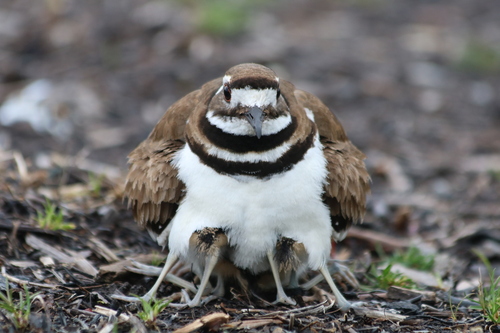
Killdeer
Charadrius vociferus
Near threatenedEnglish
The killdeer (Charadrius vociferus) is a large plover found in the Americas. Its shrill, two-syllable call is often heard, sounding like "kill deer". It was described and given its current scientific name in 1758 by Carl Linnaeus in the 10th edition of his Systema Naturae. Three subspecies are described. Its upperparts are mostly brown with rufous fringes, the head has patches of white and black, and two black bands cross the breast. The belly and the rest of the breast are white. The nominate (or originally described) subspecies breeds from southeastern Alaska and southern Canada to Mexico. It is seen year-round in the southern half of its breeding range; the subspecies C. v. ternominatus is resident in the West Indies, and C. v. peruvianus inhabits Peru and surrounding South American countries throughout the year. North American breeders winter from their resident range south to Central America, the West Indies, and the northernmost portions of South America. The nonbreeding habitat of the killdeer includes coastal wetlands, beach habitats, and coastal fields. Its breeding grounds are generally open fields with short vegetation (but locations such as rooftops are sometimes used); although it is a shorebird, it does not necessarily nest close to water. The nest itself is a scrape lined with vegetation and white material, such as pebbles or seashell fragments. This bird lays a clutch of four to six buff to beige eggs with dark markings. The breeding season (starting with egg-laying) occurs from mid-March to August, with later timing of egg-laying in the northern portion of the range. Both parents incubate the eggs for 22 to 28 days typically. The young stay in the nest until the day after being hatched, when they are led by their parents to a feeding territory (generally with dense vegetation where hiding spots are abundant), where the chicks feed themselves. The young then fledge about 31 days after hatching, and breeding first occurs after one year of age. The killdeer primarily feeds on insects, although other invertebrates and seeds are eaten. It forages almost exclusively in fields, especially those with short vegetation and with cattle and standing water. It primarily forages during the day, but in the nonbreeding season, when the moon is full or close to full, it forages at night, likely because of increased insect abundance and reduced predation during the night. Predators of the killdeer include various birds and mammals. Its multiple responses to predation range from calling to the "ungulate display", which can be fatal for the performing individual. The killdeer was formerly considered a least-concern species by the IUCN due to its large range and population, but is now considered a near-threatened species due to its population decline, though the decline is not rapid enough to warrant uplisting the killdeer to a vulnerable species. It is protected by the American Migratory Bird Treaty Act of 1918 and the Canadian Migratory Birds Convention Act.
Français · Pluvier kildir
Le Pluvier kildir ou Gravelot kildir est une espèce d'oiseaux Charadriiformes de la famille des Charadriidae. C'est un petit limicole présent en Amérique, du nord du Canada jusqu'aux côtes du Pérou. Les populations boréales migrent.
Español · Chorlo tildío
El chorlitejo colirrojo o chorlo gritón (Charadrius vociferus) en náhuatl (apanchane tototl) es una especie de ave Charadriiforme de la familia Charadriidae propia de América. Se considera una ave migratoria. Su tamaño es nediano de entre 24cm y 25 cm de envergadura.
Русский · Крикливый зуёк
Крикливый зуёк — вид птиц из семейства ржанковых.
العربية · زقزاق صياح
زقزاق صياح أو الزقزاق الأمريكي أو الكِلدِيّ هو نوع من الطيور يتبع جنس الزقزاق من فصيلة الزقزاقية.
中文 · 雙領鴴
双领鸻 是是一种发现于美洲的大型鸻。1758年,卡尔·林奈在《自然系统第10版》中描述并赋予了它现在的学名。描述了三个亚种。它的上半身大多是棕色的,带有红褐色的流苏,头部有白色和黑色的斑块,胸部有两条黑色带。腹部和胸部的其余部分是白色的。
Photo: Owen J. · CC-BY-NC · View on iNaturalist · Wikipedia
See my other TRMNL plugins