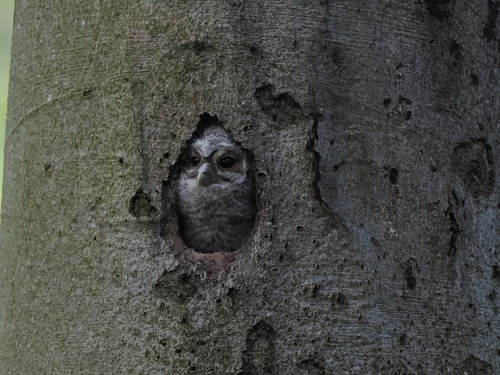
Tawny Owl
Strix aluco
English
The tawny owl (Strix aluco), also called the brown owl, is a stocky, medium-sized owl in the family Strigidae. It is commonly found in woodlands across Europe, as well as western Siberia, and has seven recognized subspecies. The tawny owl's underparts are pale with dark streaks, whilst its upper body may be either brown or grey (in several subspecies, individuals may be of both colours). The tawny owl typically makes its nest in a tree hole where it can protect its eggs and young against potential predators. It is non-migratory and highly territorial: as a result, when young birds grow up and leave the parental nest, if they cannot find a vacant territory to claim as their own, they will often starve. The tawny owl is a nocturnal bird of prey. It is able to hunt successfully at night because of its vision, hearing adaptations and ability to fly silently. It usually hunts by dropping suddenly from a perch and seizing its prey, which it swallows whole. Its typical prey are rodents, although in urbanised areas its diet includes a higher proportion of birds. It also sometimes catches smaller owls, and is itself sometimes hunted by the eagle owl and the Eurasian goshawk. Its retina is no more sensitive than a human's. Its directional hearing skill is more important to its hunting success: its ears are asymmetrically placed, which enables it to more precisely pinpoint the location from which a sound originates. The tawny owl holds a place in human folklore: because it is active at night and has what many humans experience as a haunting call, people have traditionally associated it with bad omens and death. Not all owl species make a hooting sound. The double hoot, the tawny owl's prototypical call, is a call and response between a male and a female.
Français · Chouette hulotte
La Chouette hulotte ou Chat-huant, est une espèce d'oiseaux de la famille des Strigidae. Ce rapace nocturne est très répandu en Eurasie, notamment en Europe.
Español · Cárabo
El cárabo común es un ave rapaz de tamaño medio del orden de las estrigiformes que es común en los bosques de gran parte de Eurasia y de algunas zonas del centro y este de Asia. El plumaje de su parte ventral es pálido con rayas oscuras, mientras que el de su parte dorsal puede ser marrón o gris, aunque varias de las once subespecies reconocidas presentan ambas variantes de coloración. Generalmente construye su nido dentro del hueco de un árbol, y los huevos y recién nacidos son protegidos ferozmente por los padres de los posibles depredadores. Es un ave no migratoria y altamente territorial, lo que provoca que muchos ejemplares jóvenes mueran de hambre si no pueden encontrar un territorio vacante una vez que se separan de los padres.
Русский · Серая неясыть
Се́рая нея́сыть, или обыкнове́нная нея́сыть — вид птиц семейства совиных. Выделяют 7 подвидов. Распространены на большей части территории Европы, а также в Центральной Азии.
العربية · بوم أسمر
الخَبَل أو البومة السمراء الأوراسية طائر يتبع جنس البوم ضمن رتبة البوميات، هذا الطائر الليلي الجارح يوجد على نطاق واسع في أوربّة وآسية وشمال إفريقيا.
中文 · 西灰林鴞
西灰林鸮 是林鴞屬的一種中型貓頭鷹,普遍分布在歐亞大陸的林地。下身淡色及有深色的條紋,上身呈褐色或灰色,已知11個亞種中有幾種不同的色型。一般會在樹孔中築巢,並會保護鳥蛋及雛鳥。灰林鴞不遷徙,有高度的區域性,雛鳥若離開父母後若不能找到領土就要面對捱餓的可能。
Photo: Timo Leistner · CC-BY-SA · View on iNaturalist · Wikipedia
See my other TRMNL plugins