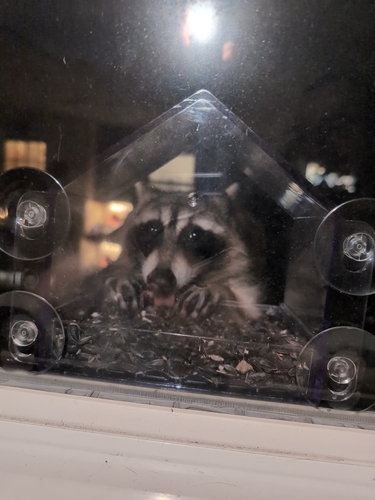
Common Raccoon
Procyon lotor
English
The raccoon ( or US: , Procyon lotor), sometimes called the North American, northern or common raccoon (also spelled racoon) to distinguish it from other species of raccoon, is a mammal native to North America. It is the largest of the procyonid family, having a body length of 40 to 70 cm (16 to 28 in), and a body weight of 5 to 26 kg (11 to 57 lb). Its grayish coat mostly consists of dense underfur, which insulates it against cold weather. The animal's most distinctive features include its extremely dexterous front paws, its facial mask, and its ringed tail, which are common themes in the mythologies of the Indigenous peoples of the Americas surrounding the species. The raccoon is noted for its intelligence, and studies show that it can remember the solution to tasks for at least three years. It is usually nocturnal and omnivorous, eating about 40% invertebrates, 33% plants, and 27% vertebrates. The original habitats of the raccoon are deciduous and mixed forests. Still, due to their adaptability, they have extended their range to mountainous areas, coastal marshes, and urban areas, where some homeowners consider them to be pests. As a result of escapes and deliberate introductions in the mid-20th century, raccoons are now also distributed across central Europe, the Caucasus, and Japan. In Europe, the raccoon has been included on the list of Invasive Alien Species of Union Concern since 2016. This implies that this species cannot be imported, bred, transported, commercialized, or intentionally released into the environment in the whole of the European Union. Though raccoons were previously thought to be generally solitary, there is now evidence that they engage in sex-specific social behavior. Related females often share a common area, while unrelated males live together in groups of up to four raccoons to maintain their positions against foreign males during the mating season and against other potential invaders. Home range sizes vary anywhere from 3 ha (7.4 acres) for females in cities, to 5,000 ha (50 km2; 19 sq mi) for males in prairies. After a gestation of about 65 days, two to five young known as "kits" are born in spring. The kits are subsequently raised by their mother until dispersal in late fall. Although captive raccoons have been known to live over 20 years, their life expectancy in the wild is only 1.8 to 3.1 years. In many areas, hunting and vehicular injury are the two most common causes of death.
Français · Raton laveur commun
Le Raton laveur, ou Raton laveur commun, est une espèce de mammifères de l'ordre des Carnivores et de la famille des Procyonidés.
Español · Mapache
El mapache boreal o mapache común es una especie de mamífero carnívoro de la familia Procyonidae. Es omnívoro y de tamaño mediano, pesa entre 5 y 15 kg. Es característica de esta especie la coloración oscura de su piel alrededor de los ojos y la cola con colores claros y oscuros alternados como anillos. Su pelaje puede ser gris, marrón o negro, muy raramente albino.
Русский · Енот-полоскун
Ено́т-полоску́н, или америка́нский енот , — хищное млекопитающее рода еноты семейства енотовых. Один из немногих видов, которые процветают в условиях усиления антропогенного воздействия, выражающегося в постепенном окультуривании угодий.
العربية · راكون شائع
الرَاكُون الغاسل أو الرَاقُون الغاسل أو الرَاتُون الغاسل، أو ببساطة الرَاكُون أو الرَاقُون أو الرَاتُون ، هو حيوان ثديي من آكل للحوم يستوطن أنحاء متفرقة من الولايات المتحدة وجنوب كندا وتعني كلمة الراكون في لغة سكان أمريكا الشمالية الأصليين تعني الحيوان الذي يدلك بيديه.
中文 · 浣熊
浣熊属哺乳纲食肉目浣熊科的一种动物。源自北美洲。前爪上有一層角質層,有時候需要浸在水裡使其軟化來提高靈敏度,所以看起來就像是把食物或者其他物品清洗乾淨,故名为浣熊。
Photo: comradejon · CC-BY-NC · View on iNaturalist · Wikipedia
See my other TRMNL plugins